
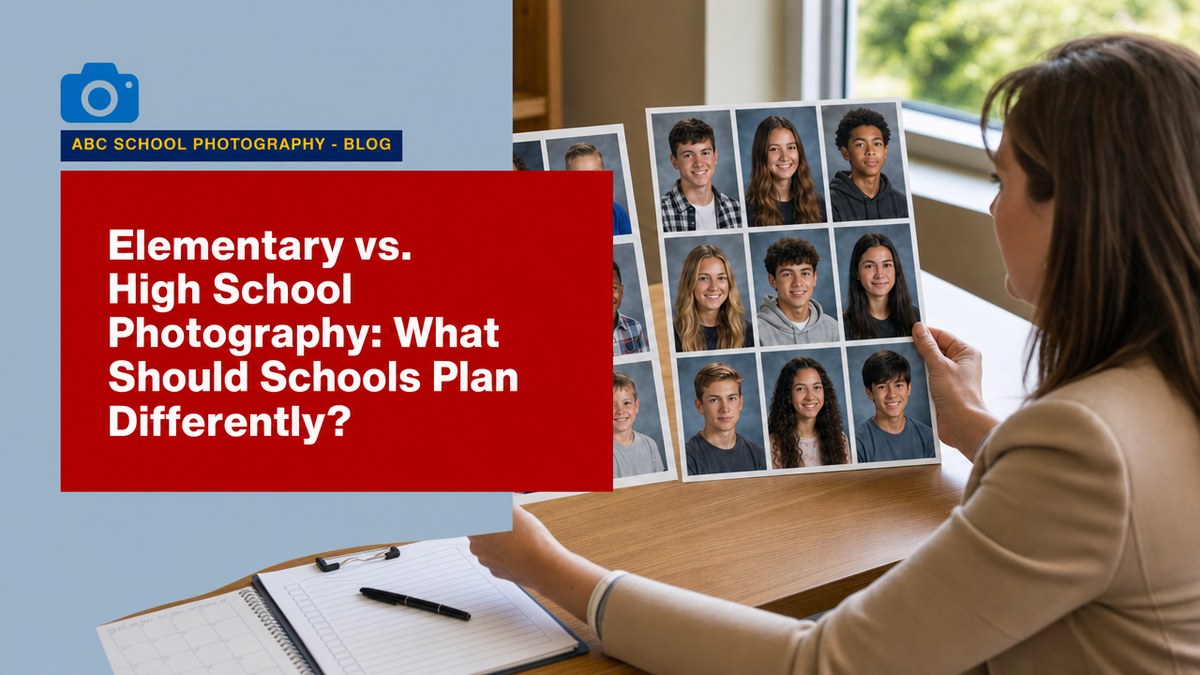
Picture Day works best when it reflects the way your school operates. Elementary and high schools may choose different schedules, portrait styles, communication plans, and yearbook requirements. That does not mean one approach is better than another. It means administrators should identify the needs of each campus before selecting a photography plan.
When evaluating elementary and high school photography, begin with the intended use of every image. Then consider student age, school routines, family communication, privacy requirements, and the yearbook production schedule. A clear plan can reduce confusion for staff and students while giving families useful information before Picture Day.
Start with the intended use of the portraits
Before discussing backgrounds or dates, determine what the photography program needs to produce. The requirements for an elementary campus may differ from those for a high school yearbook or graduating class, but the final plan should always reflect the individual school.
- Individual portraits for yearbook pages or student records
- Classroom, advisory, grade-level, or student-body group photographs
- Staff and faculty portraits
- Family print orders
- Underclass and senior yearbook sections
- Make-up or retake images for absent students
One campus might request a group photograph for each elementary classroom, while another might have separate specifications for high school underclass and senior portraits. Provide prospective photography providers with a precise deliverables list rather than assuming every grade or campus will follow the same format.
Ask which students need individual portraits, which groups must be photographed, whether staff images are required, and whether senior portraits are part of the regular Picture Day or a separate event. These decisions affect the schedule, communication plan, staffing needs, and yearbook deadlines.
Choose backgrounds and styling for the school community
Age-appropriate styling should not be reduced to a rule that younger students need playful backgrounds and older students need formal ones. School culture, yearbook design, family expectations, dress requirements, and the intended use of the images all matter.
An elementary school might choose a colorful or whimsical setting, but it could also prefer a neutral background that works consistently from kindergarten through the upper grades. A high school might select a traditional presentation, a background that complements its yearbook layout, or a distinct look for graduating students. These are choices for each school to evaluate, not universal grade-level requirements.
Review background samples before approving the setup. Consider whether common clothing colors will contrast clearly with the setting, whether the design will remain appropriate across the participating grades, and whether senior or graduation portraits require a separate visual direction. We offer lower-grade themes as well as traditional backgrounds suitable for students of different ages. Our Yearbook & Class Photos service also includes consistent lighting and backgrounds for individual yearbook portraits.
Balance consistency with natural expressions
A yearbook needs enough consistency for portraits to work together on the page. Consistency may include framing, background, crop, and general posture. It does not require every student to produce exactly the same expression.
Administrators can make the experience more predictable by explaining where students will go, what will happen, and who can help if they feel uncertain. General guidance from the American Academy of Pediatrics emphasizes predictable routines, listening to concerns, and planning ahead for situations that may cause worry. Although this guidance is not specific to photography, those principles can help schools prepare students for an unfamiliar activity.
- Give teachers or advisers a simple explanation to share with students.
- Avoid implying that there is only one correct smile or expression.
- Identify how students can request assistance if they feel uncertain.
- Decide what happens if a student declines or cannot complete a portrait.
- Use established school procedures to arrange approved supports.
- Ask your district’s privacy contact which personnel may receive student information.
The amount and type of preparation should reflect the students and routines on your campus. Some students may benefit from a classroom explanation, while others may respond better to a short written notice or reminder. High school administrators should clearly communicate any dress expectations, senior-yearbook requirements, portrait deadlines, and image-selection procedures that apply. A written plan avoids relying on assumptions about what students or families already know.
Build the schedule around the actual school day
An elementary campus might move students by classroom or homeroom. A high school might use periods, advisories, grade assignments, or individual appointments. Either campus could require a different model based on lunch schedules, transportation, special programs, available space, and the number of students participating.
Start by mapping the photography schedule against arrival, dismissal, lunch, recess, classes, assemblies, testing, and other fixed activities. Decide how students will move to and from the photography area, where they will wait, who will supervise them, and how absences will be recorded.
At ABC School Photography, we coordinate bell schedules, class lists, and traffic flow before Picture Day. We can build the photography schedule around periods and lunch blocks, but the proposed plan should still be checked against your campus calendar and daily routines.
Before approving the schedule, ask:
- Will students arrive by class, grade, advisory, or individual appointment?
- How can portraits be scheduled while limiting unnecessary disruption?
- Where will students wait, and who will supervise them?
- Who checks names against the school roster?
- How will late arrivals and absences be recorded?
- When will staff and faculty members be photographed?
- Are class groups required, and where will they be assembled?
- When must final images reach the yearbook team?
A school with a period-based schedule may need to consider students who attend off-campus programs or have different lunch blocks. A classroom-based campus may need to plan around specials, recess, or transportation. These are operational differences to investigate during planning rather than assumptions to make based only on grade level.
Connect Picture Day to yearbook production
Photography and yearbook planning should be treated as one connected project. Before Picture Day, the administrator, yearbook adviser, and photography provider should confirm the required crop, background, file format, naming convention, grade assignment, and delivery deadline.
If the school has a senior section, confirm its requirements and the date by which initial or retake images are needed. If classroom, advisory, grade-level, or other group photographs will appear in the yearbook, identify those groups in advance. Staff portraits should also be scheduled early enough to meet the yearbook team’s production calendar.
Our yearbook and class photography services include individual portraits for yearbook pages and student records, class group photographs, and staff and faculty headshots as needed. We also offer make-up or retake options for absent students. Schools should confirm their schedule, image specifications, responsibilities, and deadlines in writing before Picture Day.
Confirm the yearbook handoff
The yearbook team should know who will receive the files, how student names and grades will be matched, and who is responsible for reviewing the information. If students can select their yearbook image, document the selection method and deadline. If the school makes the selection, identify the person responsible for approval.
Also decide how corrections will be reported. A clear process for name, grade, or group-assignment questions can prevent uncertainty later in the yearbook schedule.
Tailor communication to your school community
The right communication plan depends on who needs to take action. At one school, parents or guardians may handle clothing choices, ordering, and absence questions. At another, students may need to remember an appointment, follow an attire requirement, or meet a senior portrait deadline. Many schools will need communication directed to both students and families.
A Picture Day notice should state the date, clothing guidance if applicable, what students can expect, how families order photographs, what happens after an absence, and whom to contact with questions. Use plain language and distinguish between required school photography and optional products or sessions.
Choose communication channels that fit your community. Options may include email, printed notices, student announcements, family portals, classroom reminders, or adviser messages. The goal is not to use every channel. It is to make important dates and responsibilities clear to the people who need them.
Review privacy procedures before sharing information
Administrators should ask the district’s privacy or records contact how local policies address school portraits, yearbooks, directory information, vendor access, consent, and opt-outs. Make sure the Picture Day roster and participation procedures reflect those policies before student information is shared.
The U.S. Department of Education’s FERPA guidance on photographs and videos explains that a photograph may be an education record when it is directly related to a student and maintained by the school or by a party acting for the school. Whether an image is directly related to a student is context-specific.
School photography does not have one universal consent or opt-out rule for every situation. Follow your district’s approved procedures and clarify how participation choices will be communicated to authorized staff and the photography team. Ask your district’s privacy contact what information may be shared and who may receive it.
Questions to resolve before Picture Day
Whether your campus serves elementary students, high school students, or both, obtain clear answers before signing an agreement or sending a family notice.
- Which individual portraits and group photographs are included?
- What background and portrait style will be used for each participating group?
- Who approves background samples and yearbook specifications?
- How will the schedule fit classes, periods, lunch blocks, and special programs?
- What student information is necessary for the photography program?
- How will approved student supports be arranged under school procedures?
- What happens when a student does not participate?
- How are privacy choices and opt-outs identified?
- Who verifies names, grades, and group assignments?
- What are the yearbook deadlines and required file specifications?
- How will absent students and retakes be handled?
- Who communicates ordering information to families?
- Who is the school’s day-of contact?
- Which deliverables, dates, and responsibilities will appear in the agreement?
The strongest plan is not one that forces every campus into the same Picture Day model. One elementary school may prefer classroom movement and detailed advance preparation, while another uses grade-level blocks. One high school may schedule students by period, while another relies on advisories or individual appointments. Communication could focus on families, students, or both depending on who needs to act.
At ABC School Photography, we work with schools from elementary through high school. Our services include individual yearbook portraits, class group photographs, staff and faculty headshots as needed, and make-up or retake options for absent students. Contact us to coordinate your Picture Day schedule and selected photography services. Your school or district should establish the privacy procedures that apply.

